


Thinking about selling your business or partnering with a capital group? This guide breaks down how capital groups differ from private equity, the four main exit paths, what buyers look for, and how the acquisition process works — helping business owners make informed, strategic decisions.
What Is a Capital Group, and How Is It Different From a Private Equity Firm?
The term “capital group” gets used loosely, but in the context of business acquisitions, it typically refers to a private investment vehicle – often a family office or closely held fund – that acquires and holds businesses over the long term.
The distinction matters, because private equity firms and capital groups operate very differently:
| Private Equity Firm | Capital Group / Family Office | |
| Hold period | Typically 3–5 years before exit | Often 5–10+ years, sometimes indefinite |
| Primary goal | Maximize return for fund investors | Sustainable value creation and income |
| Approach to management | Often replaces leadership | Typically retains existing team |
| Deal size focus | Usually $10m+ EBITDA | Often $300k–$5m EBITDA |
| Decision speed | Can be slow due to committee processes | Faster, more direct |
For owners of smaller, mature businesses – particularly those with EBITDA under $5m – a capital group is often a far more appropriate and aligned buyer than a traditional private equity firm.
According to the Exit Planning Institute, fewer than 20% of businesses listed for sale actually complete a transaction. One of the leading reasons is a mismatch between what the seller expects and what most buyers are structured to offer. Understanding the type of buyer you are dealing with changes everything.
The Four Main Paths: Which One Is Right for You?
Before you engage with any buyer, it helps to be clear on what outcome you are actually seeking. Most owners fall into one of four categories:
1. Full Exit
You want to sell the business outright, exit cleanly, and move on — whether to retirement, a new venture, or simply time back. A clean full acquisition is the right structure here.
2. Partial Exit (Liquidity Event)
You want to take some chips off the table — unlock personal liquidity — while retaining an equity stake and staying involved in the business. This is increasingly common and can be structured as a majority or minority stake sale.
3. Growth Partnership
Your business is performing well, but you have hit a ceiling — capital constraints, operational bandwidth, or geographic limitations. You want a partner who brings resources and expertise, not just money.
4. Succession and Transition
You are ready to step back, but there is no obvious internal successor. A capital group can provide continuity for your team, your clients, and your legacy while giving you a structured exit.
Being honest with yourself about which of these applies will save you significant time and prevent you from engaging with buyers who are not aligned with your goals.

Being honest with yourself about which of these applies will save you significant time and prevent you from engaging with buyers who are not aligned with your goals.
What Capital Groups Actually Look For
This is the question most owners ask too late in the process.
Capital groups — particularly those focused on mature, established businesses — are looking for a specific profile. Understanding this profile helps you assess your own readiness and, if needed, address gaps before going to market.
Consistent, Verified EBITDA
This is the single most important metric. Capital groups want to see several years of steady earnings before interest, taxes, depreciation, and amortisation. A single strong year is not compelling. Three to five years of consistency is.
The Harvard Business Review has consistently noted that earnings quality — not just earnings level — is what sophisticated buyers scrutinise. That means removing one-off items, owner-specific expenses, and anything that distorts the true underlying profitability of the business.
A Management Team That Does Not Depend on You
If the business cannot function without the founder present, it is not a business — it is a job. Capital groups want to see that there is a team capable of running operations, managing clients, and driving performance independently.
This does not mean you need to be irrelevant to the business. It means there needs to be genuine organisational depth beneath you.
Documented Systems and Processes
Businesses that rely on institutional knowledge held in people’s heads — rather than documented systems — carry higher risk. Buyers will discount for this. A business with clear SOPs, repeatable processes, and documented client relationships is demonstrably more valuable.
Clean Financials
This sounds obvious, but it is one of the most common deal-killers. Three years of clean, professionally prepared accounts — ideally audited or at minimum reviewed — significantly accelerate due diligence and reduce buyer anxiety.
The Institute of Chartered Accountants in England and Wales (ICAEW) provides guidance on financial statement preparation that is worth reviewing before any sale process.
Customer and Revenue Concentration
If more than 30% of your revenue comes from a single client, most buyers will identify this as a material risk. It does not necessarily kill a deal, but it will affect valuation and may influence deal structure.
The Acquisition Process: What to Expect, Stage by Stage
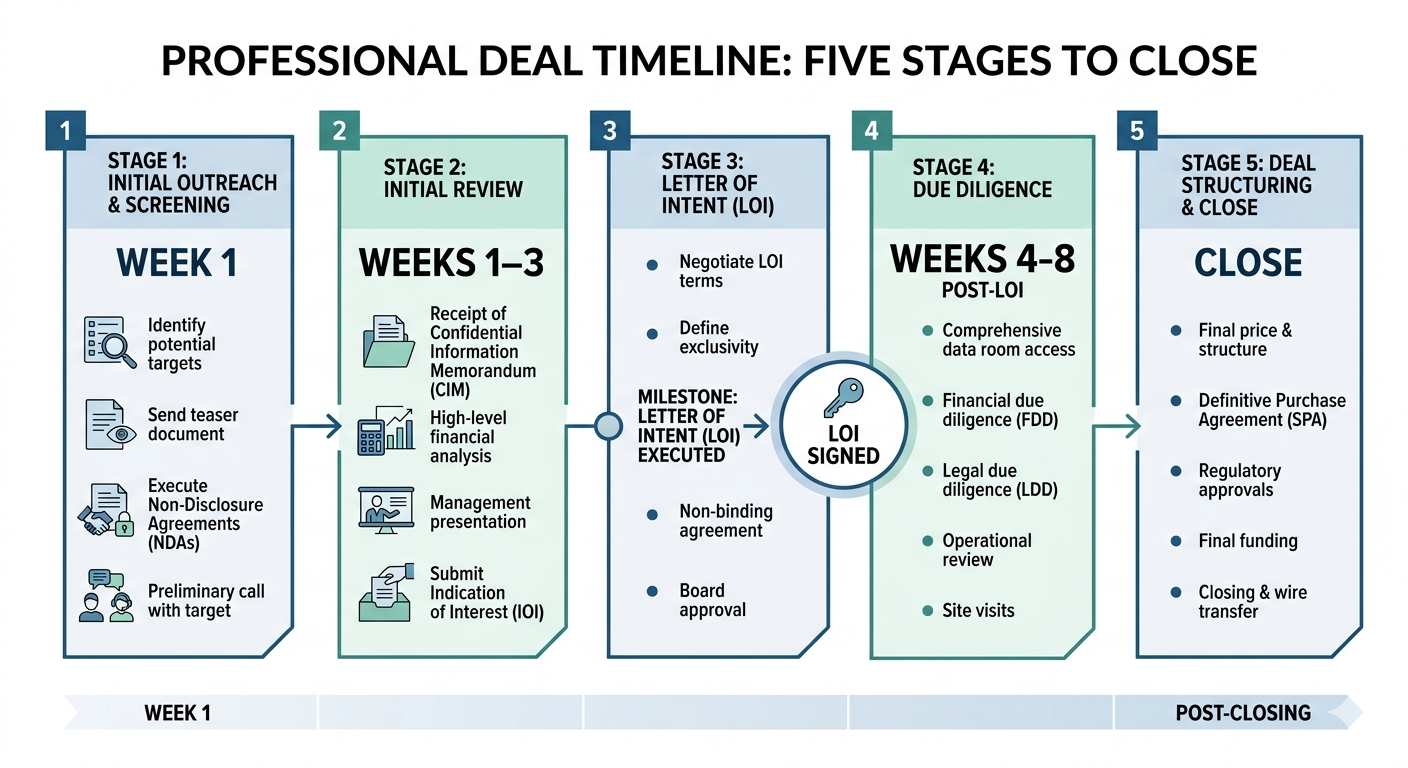
One of the biggest sources of anxiety for sellers is simply not knowing what comes next. Here is a realistic overview of how the process unfolds when working with a reputable capital group.
Stage 1: Initial Outreach and Screening (Week 1)
You make contact — either directly or through an advisor. The capital group conducts an initial screening based on size, sector, geography, and financial profile. This should take no more than a week and result in clear feedback: yes, no, or not yet.
Stage 2: Initial Review (Weeks 1–3)
If there is appetite to proceed, you will be asked for an Information Memorandum (IM) or a Confidential Business Review (CBR). This document summarises your business, financials, team, and opportunity. The capital group will review this and meet with you — either in person or virtually — to ask questions and share their perspective.
At this stage, nothing is agreed. You are both assessing fit.
Stage 3: Letter of Intent (LOI)
If both sides want to proceed, the capital group will issue a Letter of Intent — a non-binding document that sets out the headline terms of the proposed transaction: price, structure, and key conditions. This is a significant moment, but it is not a done deal.
The Association for Corporate Growth (ACG) provides useful guidance on what a well-structured LOI should contain.
Stage 4: Due Diligence (Weeks 4–8 Post-LOI)
This is the most intensive phase. The buyer will conduct financial, legal, commercial, and operational due diligence. You will be asked for documents, data, and explanations. The quality of your preparation at this stage directly affects the outcome.
Common due diligence requests include:
- Three to five years of financial statements
- Tax returns
- Customer and supplier contracts
- Employment agreements
- Intellectual property documentation
- Any outstanding legal matters
Stage 5: Deal Structuring and Close
Once diligence is complete and both parties are satisfied, you move to final documentation — a Share Purchase Agreement (SPA) or Asset Purchase Agreement (APA) — and close. With a prepared seller and a decisive buyer, this stage should not take more than two to three weeks.
Common Deal Structures: What the Numbers Actually Look Like
Not all acquisitions are simple cash-at-close transactions. Understanding common deal structures helps you evaluate offers intelligently.
Full Cash at Close
The buyer pays 100% of the agreed price on completion. This is the cleanest structure and commands the highest seller satisfaction — but it also typically comes with the most rigorous due diligence, because the buyer carries all the risk from day one.
Earnout
Part of the purchase price is deferred and paid based on the business achieving certain performance targets post-acquisition. Earnouts are often used when there is a valuation gap between buyer and seller, or when the buyer wants to manage transition risk.
According to Deloitte’s M&A Trends Report, earnout provisions appear in a significant proportion of mid-market deals, particularly where future performance is uncertain or highly dependent on the outgoing owner.
Seller’s Note / Vendor Financing
The seller effectively lends part of the purchase price to the buyer, to be repaid over time with interest. This reduces the immediate cash requirement for the buyer and can sometimes result in a higher overall price for the seller.
Equity Rollover
The seller reinvests a portion of their proceeds into the acquiring entity, retaining a stake in the combined business. This aligns incentives post-transaction and can be highly lucrative if the buyer executes well.
Preparing Your Business for a Transaction: A Practical Checklist
Preparation is the single biggest lever sellers have over their outcome. Businesses that go to market well-prepared achieve higher valuations, face fewer deal complications, and close faster.
Financial Preparation
- Ensure three years of clean, professionally prepared financial statements are available
- Normalise EBITDA by removing personal expenses and one-off items
- Reconcile any discrepancies between management accounts and statutory accounts
- Prepare a clear breakdown of capital expenditure and working capital requirements
Operational Preparation
- Document key processes, workflows, and standard operating procedures
- Identify and reduce dependency on any single individual, including the founder
- Ensure customer and supplier contracts are current, in writing, and transferable
Legal Preparation
- Confirm ownership of all intellectual property
- Resolve any outstanding disputes, claims, or compliance issues
- Ensure all employment contracts are in order
- Confirm the corporate structure is clean and well-documented
Strategic Preparation
- Prepare a clear narrative about the business: what it does, why it wins, and where it can go
- Identify and be able to articulate the main risks — buyers will find them anyway
- Be clear on your personal goals for the transaction before entering any conversation
Questions You Should Be Asking Every Buyer
Not all capital groups are created equal. When you are in early conversations with a prospective buyer, these are the questions that will tell you the most about who you are dealing with:
- How many acquisitions have you completed, and can you provide references from sellers?
- What is your typical hold period, and what does your value creation approach look like?
- What happens to existing management and staff post-acquisition?
- How do you handle due diligence, and what will you need from us?
- What deal structures do you typically use, and why?
- What does your decision-making process look like, and who needs to sign off?
- Have you ever walked away from a deal post-LOI, and why?
A buyer who answers these questions clearly, directly, and without hesitation is a buyer worth taking seriously.
A Note on Advisors
The question of whether to use an advisor — a business broker, M&A advisor, or corporate finance firm — depends on the size and complexity of your transaction and your own experience.
For most owners, having independent advice is valuable. A good advisor will help you prepare an Information Memorandum, approach the right buyers, manage the process, and negotiate on your behalf. They will also provide a buffer between you and the buyer during tense moments in the process.
The British Business Bank and the Federation of Small Businesses (FSB) both provide resources for owners navigating a transaction for the first time.
Final Thoughts
Selling or partnering with a capital group is one of the most consequential decisions you will make as a business owner. It deserves the same rigour, preparation, and clear-headedness that you have brought to every other major decision in your business.
The best transactions happen when both sides know exactly what they want, communicate openly, and work towards a structure that genuinely serves both parties. That is the standard worth holding every buyer — and every process — to.
If you are exploring your options and want a confidential conversation with a capital group that invests in mature, proven businesses in Greece and the United Kingdom, Thireos Ventures is happy to hear from you.